
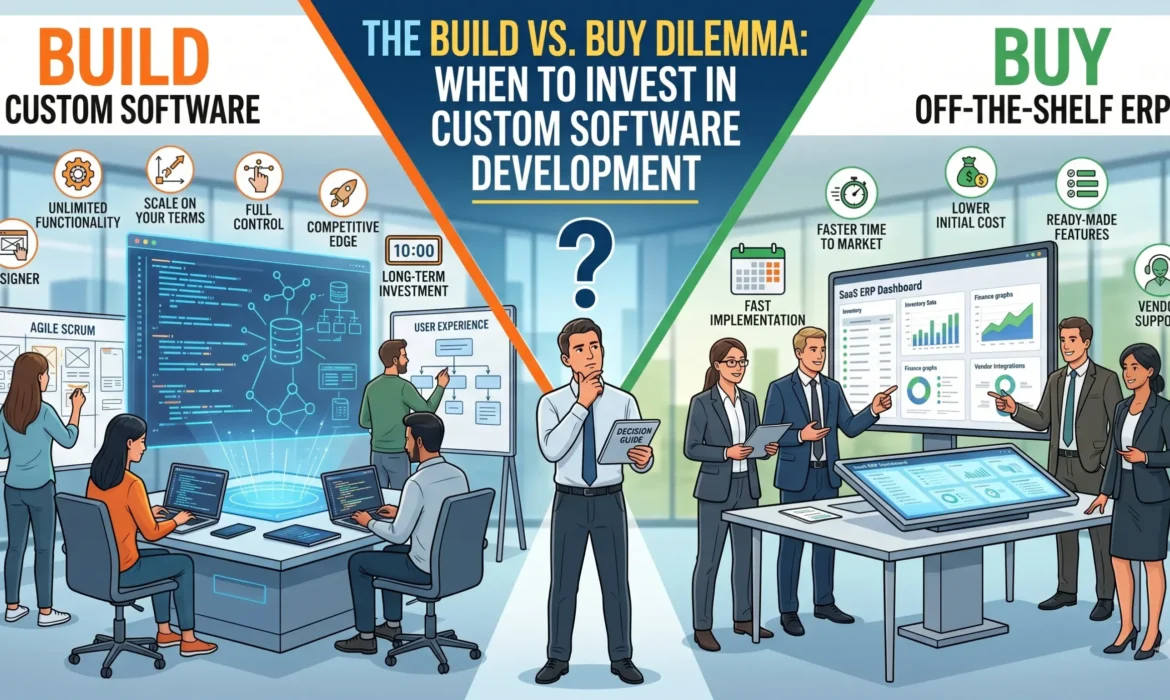
When a business decides to digitalize an internal process or launch a new digital service, they quickly arrive at a critical crossroads: the “build vs. buy” dilemma. Do you purchase a ready-made Software as a Service (SaaS) platform, or do you invest in custom software development tailored to your exact specifications?
There is no universal answer, but making the wrong choice can lead to massive technical debt or expensive platform migrations down the road. Understanding the long-term trade-offs is essential for saving both capital and operational time as your business scales.
The Structural Trade-Offs at a Glance
Off-the-shelf software is highly attractive because of its speed. You pay a subscription fee, configure a few basic settings, and your team can log in the same day. However, you are renting someone else’s infrastructure. You are bound by their feature roadmaps, their pricing hikes, and their architectural limitations.
Custom software development, conversely, requires a higher upfront financial and time investment. But in return, you own the intellectual property. It is designed to adapt to your business, meaning it scales infinitely alongside your operational growth without compounding monthly user licensing fees.
When Buying Off-the-Shelf Makes Sense
You do not need to reinvent the wheel for standard business utilities. If you are looking for a generalized CRM, basic email marketing tools, or foundational corporate accounting modules, buying is almost always the smarter choice. These processes are largely identical across companies, meaning commercial software can handle them perfectly out of the box without disrupting your efficiency.
When to Invest in Custom Software Development
If your core operational workflow is what gives you a competitive advantage in the marketplace, forcing your team to use rigid, pre-built software will actively harm your business. Off-the-shelf platforms force you to alter your unique workflows to fit their software design. Custom software does the exact opposite: it is engineered completely around your proven business logic.
This is particularly critical for mid-market enterprises or companies operating within niche industries—such as automated media production, specialized logistics, or custom ERP environments. When your operational steps are proprietary, custom software bridges the gaps that SaaS platforms leave behind, allowing for seamless backend data flows and unique consumer-facing features that your rivals cannot replicate.
Integration and the Danger of “Software Frankenstein”
As businesses grow, they often buy various individual SaaS tools to solve isolated problems. Over time, they end up with an unmanageable ecosystem where the inventory system barely communicates with the sales tracker, requiring manual patches or fragile API connectors. Custom software eliminates this friction entirely. It is engineered to seamlessly integrate with your legacy databases and existing hardware, unifying your digital ecosystem into a single, high-performance engine.
The Strategic Verdict: View off-the-shelf software as a temporary utility for standard tasks, but treat custom software as a proprietary asset. If a software system directly impacts your unique value proposition or your core operational speed, building a tailored solution is the only way to truly secure your capacity to scale.

