
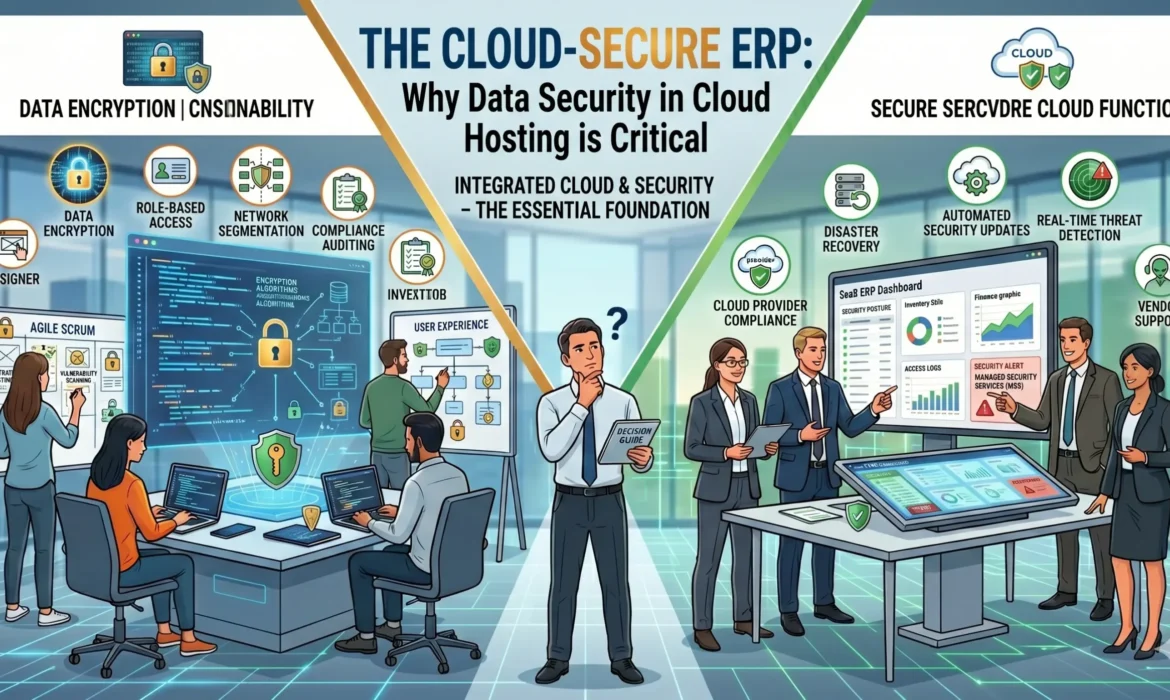
Moving your company’s core business operations to the cloud offers incredible flexibility, seamless remote access, and massive cost efficiencies. However, because an Enterprise Resource Planning (ERP) system acts as the central nervous system of your business—housing sensitive financial records, proprietary client data, and critical operational workflows—it is also a prime target for modern cyber threats.
When migrating or hosting your enterprise applications, standard security isn’t enough. You need enterprise-grade infrastructure. Understanding what keeps your corporate data safe in a cloud environment is essential for maintaining business continuity and protecting your bottom line.
1. End-to-End Data Encryption
Data must be fiercely protected in two distinct states: in transit and at rest. Data “in transit” refers to information moving live between your employees’ local devices and your cloud servers. Data “at rest” is the static information stored on server hard drives. Utilizing robust, industry-standard encryption protocols ensures that even if malicious actors manage to intercept your data packets, the underlying files remain completely unreadable and useless to them.
2. Automated Backups and Disaster Recovery
True cloud security isn’t just about building higher walls against hackers; it is about guaranteeing your business survives unexpected failures. Whether facing hardware malfunctions, localized natural disasters, or sophisticated ransomware attacks, a secure cloud setup mitigates risk through automated, redundant backups. Having isolated, daily snapshots of your ERP environment means you can restore your entire operational pipeline to a healthy state within minutes, completely eliminating catastrophic downtime.
3. Role-Based Access Control (RBAC)
Internal security vulnerabilities can be just as damaging as external threats. Not every user in your organization needs unfettered access to your core database backend or full company financial histories. Implementing Role-Based Access Control (RBAC) allows system administrators to grant specific data permissions based on an employee’s exact job description. By limiting access vectors, you minimize internal human error and prevent unauthorized data exposure.
4. Continuous Monitoring and Automated Patching
The cybersecurity landscape evolves daily, with threat actors constantly identifying new software vulnerabilities. A secure cloud infrastructure requires continuous, automated monitoring of server logs to flag unusual activity before it escalates. Furthermore, working with a team that ensures immediate security patches and system updates keeps your firewalls and protocols ahead of exploitable flaws, leaving zero windows of vulnerability.
The Operational Reality: In modern enterprise computing, a security chain is only as strong as its weakest link. Coupling high-tier cloud hosting with strict organizational habits—such as enforcing Multi-Factor Authentication (MFA) across your team—is the only way to scale safely in a digital-first economy.

