
For many startups and growing mid-market companies, spreadsheets are the ultimate operational safety net. They are free, universally understood, and endlessly customizable. In the early days, a well-built Excel workbook can handle everything from tracking inventory to calculating monthly revenue.
However, spreadsheets have a structural ceiling. As your business scales, your transaction volumes increase, your team expands, and your workflows grow more complex. What once felt like a flexible tool quickly transforms into an operational bottleneck, stalling your growth and introducing unnecessary risk.
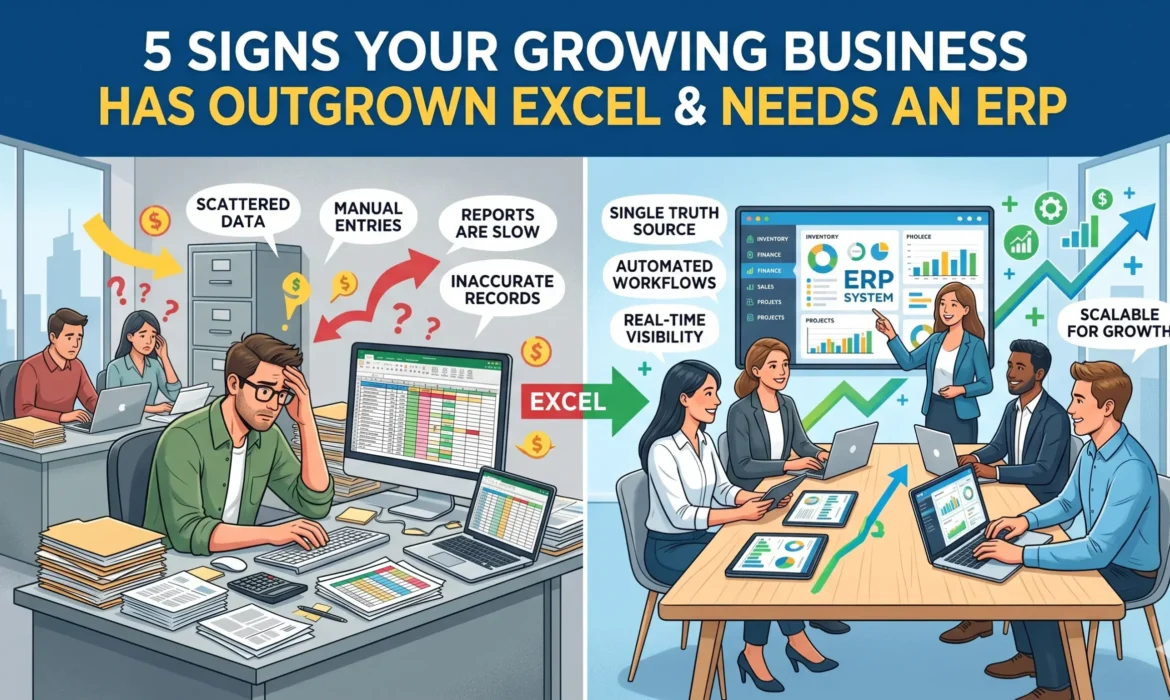
If your team is losing hours to administrative friction, it is likely time to transition to a centralized Enterprise Resource Planning (ERP) platform. Here are five unmistakable signs that your business has outgrown Excel:
1. The “Single Source of Truth” Has Vanished
When your business is small, one person usually manages the core data. As you grow, different departments—sales, inventory, procurement, and finance—start maintaining their own localized versions of the same spreadsheets. Before long, Version 2 of the sales sheet doesn’t match Version 4 of the finance sheet. When your leadership team spends more time arguing over whose data is correct rather than making strategic choices, you need a centralized ERP to sync data across the entire organization in real time.
2. Manual Data Entry Is Drowning Your Productivity
Take a close look at your team’s daily routines. Are your employees spending hours copy-pasting data between different systems, manually typing invoice details into spreadsheets, or reconciling inventory counts across multiple tabs? If so, you are wasting valuable human capital on tasks that should be automated. An ERP replaces manual entry with automated workflows, allowing your team to focus on high-value initiatives like business development and customer retention.
3. Inventory Levels and Customer Sales Are Disconnected
In modern commerce, timing is everything. If your sales team is closing deals based on an inventory spreadsheet that was manually updated yesterday, you run a massive risk of overselling. Selling stock you do not actually possess destroys customer trust and disrupts your logistics. An ERP bridges this gap entirely by linking sales orders instantly with live warehouse tracking, ensuring total transparency from checkout to delivery.
4. Compiling Reports Takes Days, Not Minutes
Answering simple business questions—such as “What was our exact net profit margin last month?” or “Which product lines are underperforming?”—should not require an archaeological dig through disconnected files. If generating an end-of-month report requires your accounting team to manually stitch together five different workbooks, your data is outdated by the time it reaches your desk. Modern ERP systems offer instant, on-demand reporting with actionable analytics.
5. Escalating Security and Compliance Risks
Spreadsheets are notoriously fragile. A single accidental keystroke or a broken cell formula can corrupt an entire financial model without anyone noticing until it is too late. Furthermore, basic Excel files lack robust security infrastructure. They cannot provide detailed audit trails showing who viewed or modified data, leaving your business highly vulnerable to data breaches, accidental loss, and compliance failures.
In conclusion: Continuing to rely on patchwork spreadsheets to run a growing enterprise is like trying to build a skyscraper on a foundation designed for a house. Upgrading to a modern, integrated ERP platform isn’t just an IT expense; it is a vital infrastructure investment that unlocks your true capacity to scale.

